Anatomy
Kidney anatomy
The kidneys are vital organs that filter the blood and produce urine. Cancer usually begins as a single mass within the kidney tissue; in the early stage the healthy part of the kidney can be preserved.
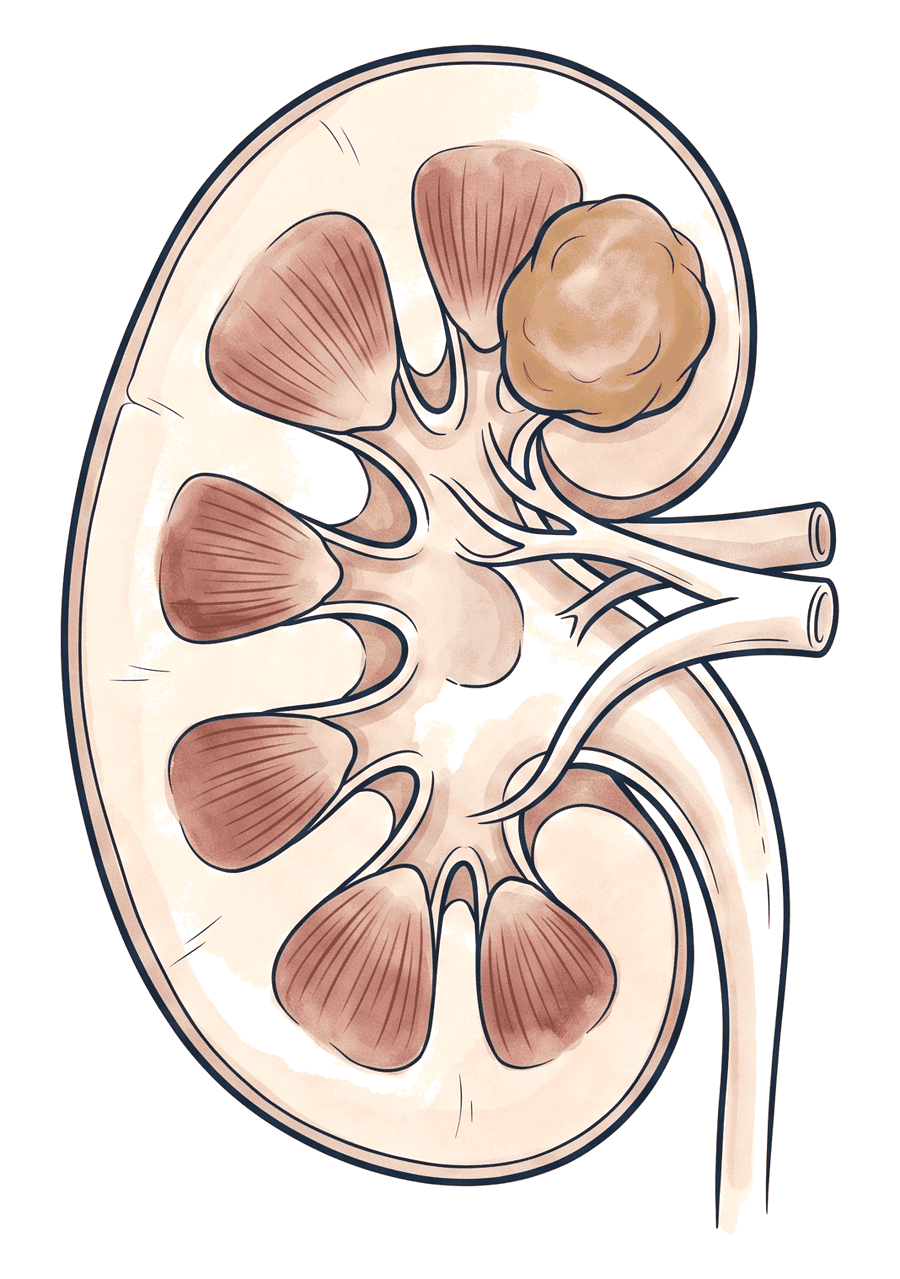
It is mostly silent and is often noticed incidentally on imaging taken for another reason. When caught early, it can be treated with the kidney preserved.
Kidney cancer occurs when cells in the kidney tissue multiply uncontrollably. The most common type in adults is "renal cell carcinoma." The cancer usually begins as a single mass (tumor).
The most striking feature of kidney cancer is that it often causes no symptoms at all. Today, most kidney cancers are caught incidentally on ultrasound or tomography taken for another complaint. This is also good news: incidentally caught tumors are usually small and at an early stage.
In small tumors confined to the kidney, it is possible to remove only the tumor-bearing part (kidney-sparing surgery) instead of the whole kidney. This approach preserves kidney function.
The kidneys are vital organs that filter the blood and produce urine. Cancer usually begins as a single mass within the kidney tissue; in the early stage the healthy part of the kidney can be preserved.
There are usually no symptoms at an early stage. The classic triad (flank pain, blood in the urine, a palpable mass) is rarely seen today, and only in advanced disease.
Blood that is visible or detected on urinalysis is a finding that needs to be investigated.
Persistent, dull pain in the flank; can be seen in advanced tumors.
A swelling felt by hand in the abdomen or flank is usually a finding of advanced disease.
Unexplained tiredness and unintended weight loss are among the general symptoms.
Prolonged fever of unknown cause and anemia may accompany it.
The most common scenario is being caught incidentally on imaging, without any symptoms.
In diagnosing kidney cancer, imaging is decisive. Most of the time, treatment is planned from imaging findings without a biopsy being needed.
A mass in the kidney is mostly noticed for the first time on ultrasound — often while it is being taken for another reason.
Whether the mass is cancer, its size and spread are assessed with contrast tomography.
When needed, MRI clarifies the features of the mass and its relationship with neighboring structures.
In necessary cases, the lungs and other regions are assessed to determine the stage of the disease.
The most common questions about kidney-sparing surgery, living with a single kidney and follow-up.
No. Especially in small and suitably located tumors, only the tumor-bearing part is removed (partial nephrectomy), and the healthy portion of the kidney is preserved. Removing the whole kidney is only preferred when necessary.
Yes. One healthy kidney can largely meet the body's needs. In cases where the kidney has to be removed, the remaining kidney takes over the function, and most patients lead a normal life.
No. Some of the kidney masses detected on imaging are benign (e.g. a simple cyst, angiomyolipoma). Whether the mass is cancer is assessed according to its features; sometimes follow-up alone is enough.
Yes, in suitable cases. Kidney cancer surgery can be done with laparoscopic or robotic methods, through small incisions. This means less pain and faster recovery. Suitability depends on the features of the tumor.
Yes. After treatment, follow-up is carried out with regular imaging and check-ups to catch a recurrence or a new problem early. The follow-up plan is personalized according to the stage of the cancer.
A kidney mass noticed on imaging can, with the right assessment, often be treated with the kidney preserved. You can reach out via WhatsApp for a preliminary consultation.