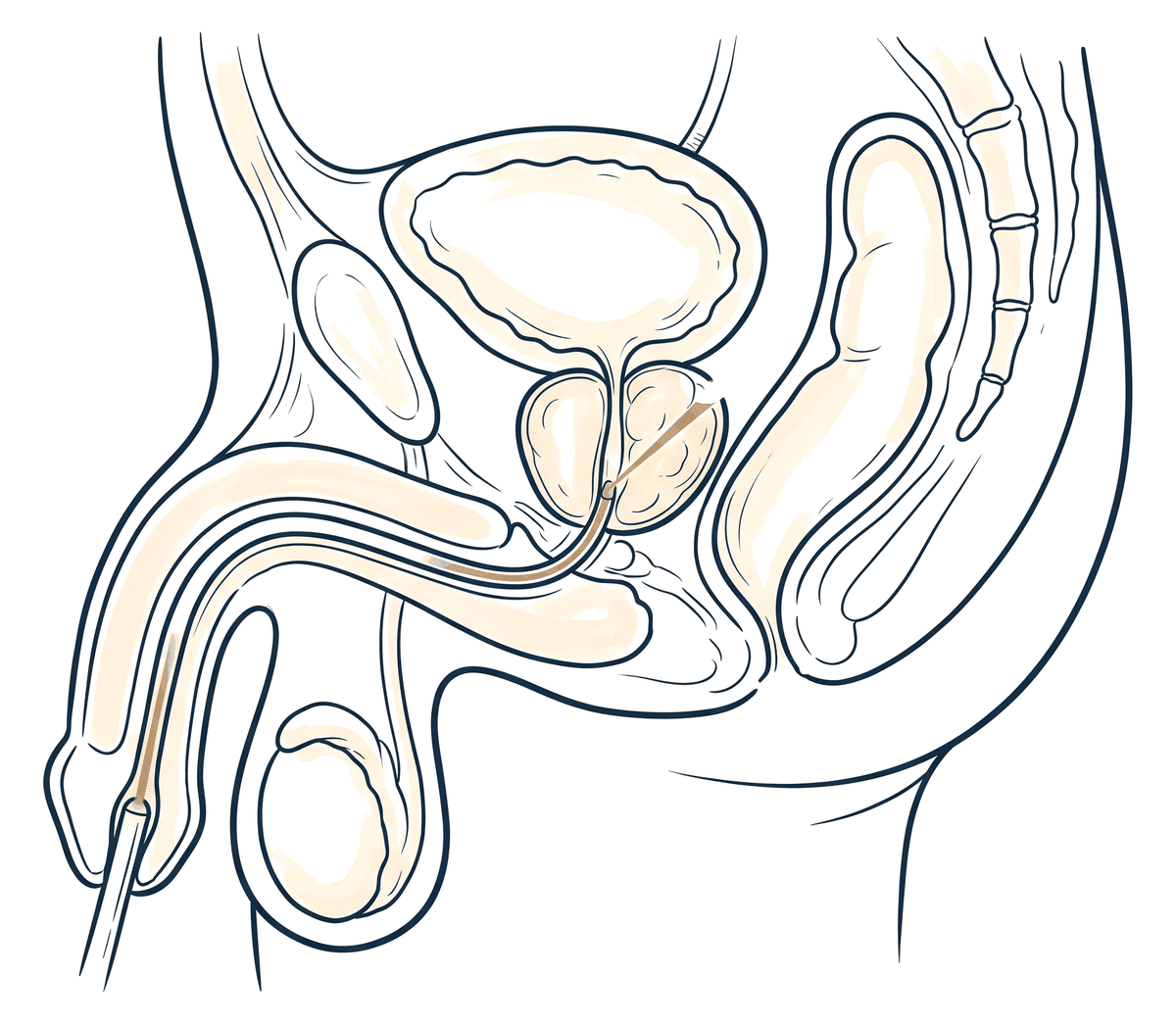
Anatomy
How is HoLEP performed?
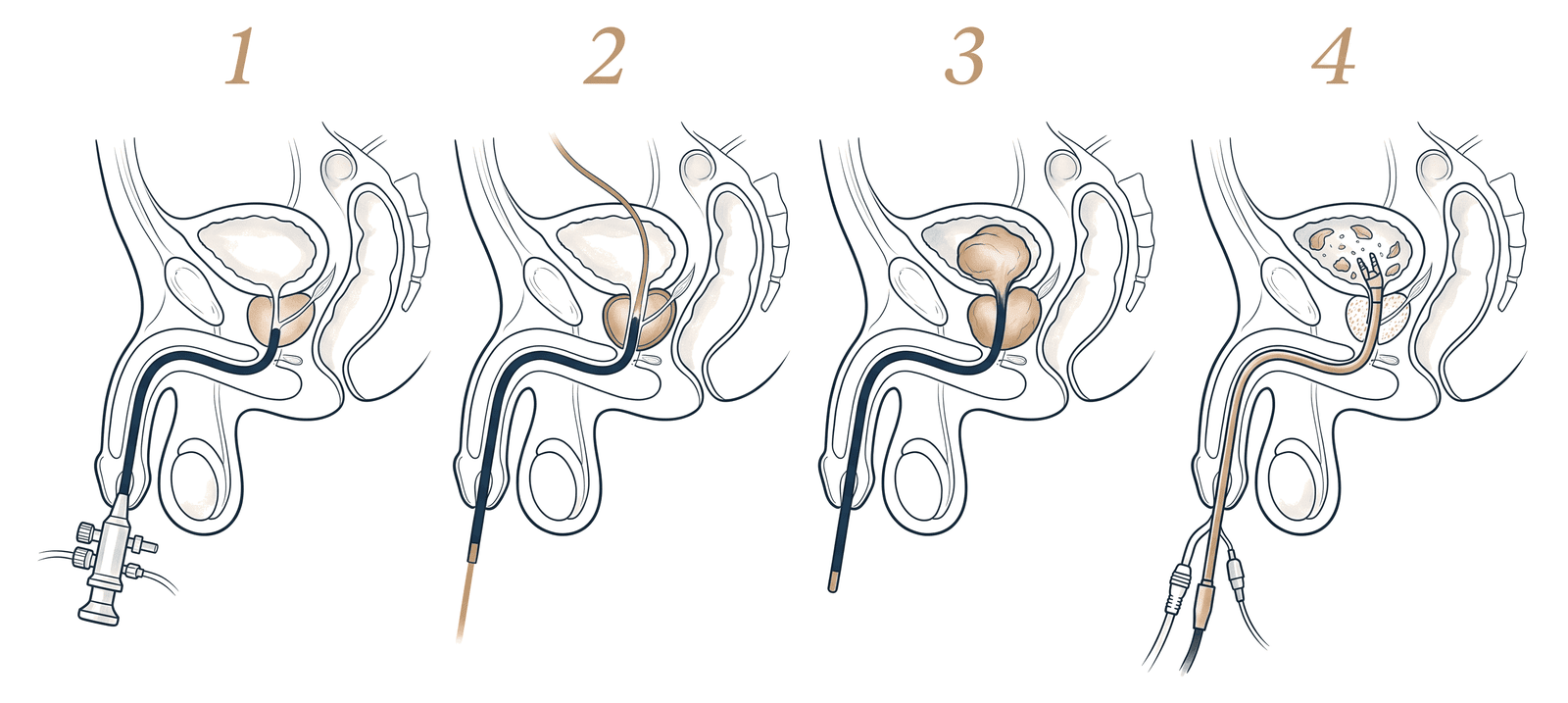
The endoscope reaches the prostate through the urethra; the enlarged tissue is separated as a whole from the capsule with the holmium laser, moved into the bladder, and removed with a morcellator.
Complete removal of the enlarged prostate with the holmium laser. Efficacy equal to open surgery, endoscopic convenience, lasting results.
HoLEP (Holmium Laser Enucleation of the Prostate) is an operation in which the enlarged prostate tissue is enucleated as a whole from the prostate capsule using an endoscopic holmium laser and pushed into the bladder. It applies the "complete removal" principle of open prostatectomy, through an endoscopic technique.
Recognized over the past decades by the European Association of Urology (EAU) Guidelines as a gold-standard option for prostates of any size, it stands out especially in prostates over 80 ml, where TUR-P falls short.
In 2022–2023, Assoc. Prof. Şenol Tonyalı won a European Association of Urology (EAU) research scholarship and worked at Universitätsklinikum Freiburg in Germany, focusing on HoLEP surgery and lasers.
HoLEP is suitable for men who experience difficulty urinating due to prostate enlargement. Situations that especially make someone a HoLEP candidate include:
The endoscope reaches the prostate through the urethra; the enlarged tissue is separated as a whole from the capsule with the holmium laser, moved into the bladder, and removed with a morcellator.
From consultation to post-recovery follow-up, the whole process is planned clearly. Our patients are informed at every stage.
Data such as uroflowmetry, PSA, voiding pattern and ultrasound are evaluated.
Anesthesia review, blood tests and choice of anesthesia type. Six hours of fasting on the day of surgery is sufficient.
The procedure usually takes 60–90 minutes. Enucleation from the prostate capsule with the laser; the tissue moved into the bladder is removed with a morcellator.
The catheter is removed within 24–48 hours. Return to work in the 1st week, full activity by the 3rd week. PSA and uroflowmetry check at 3 months.
The endoscope is placed through the urethra, the prostate lobes are separated from the capsule with the holmium laser, the separated tissue is moved into the bladder and removed by morcellation.
The clinical advantages HoLEP offers compared with open prostatectomy and classic TUR-P (transurethral resection).
While classic TUR-P is ineffective in prostates over 80 ml, HoLEP is effective even above 200 ml.
Thanks to the holmium laser's vessel-sealing property, bleeding requiring transfusion is rarely seen.
With tissue removal equivalent to open surgery, the recurrence rate is below 1%. In TUR-P this rate is 15–20%.
While open surgery requires 5–7 days in hospital, HoLEP usually needs just one night.
The catheter is removed within 24–48 hours. In open surgery this period is 7–10 days.
All removed tissue is sent to pathology. Hidden prostate cancer can be detected this way.
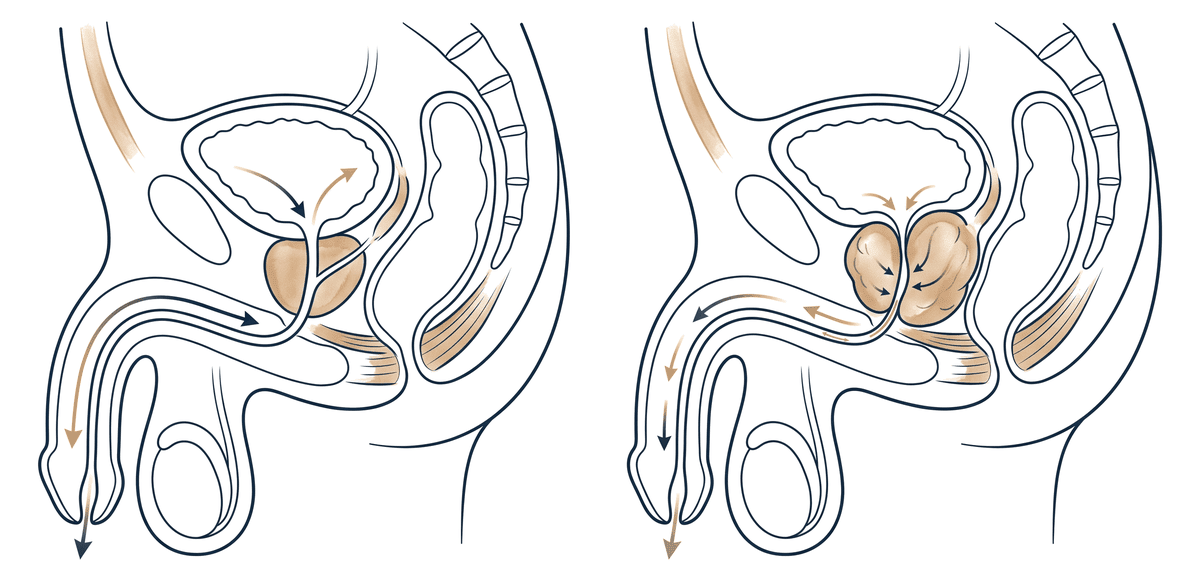
The enlarging prostate presses on the urethra and narrows urine flow. HoLEP removes this enlarged tissue as a whole, permanently relieving the flow.
The most commonly wondered topics — such as sexual function, continence and the procedure itself.
HoLEP has no negative effect on erections. However, 75–85% of patients develop "retrograde ejaculation" — semen flows back into the bladder instead of out. This does not reduce sexual pleasure. Men who wish to have children should definitely discuss this before surgery.
In the first weeks, 5–10% of patients experience temporary mild leakage. With pelvic floor exercises it usually resolves completely in 4–8 weeks. The risk of permanent incontinence is below 1%.
One week for desk jobs and 3–4 weeks for physical work is recommended. Relief in urine flow is usually felt within the first week. Complete resolution of night-time and frequent urination can take 3–6 months.
When performed at public hospitals with an SGK (Turkish social security) agreement, HoLEP is covered by SGK. As the Istanbul Faculty of Medicine is a public hospital, SGK coverage applies. Please get in touch before your appointment for the current situation.
In mild-to-moderate BPH, medications are effective. But if complaints continue despite medication, if the prostate is large (over 80 ml) or there is recurrent obstruction, HoLEP is a far more lasting and effective solution — and you avoid lifelong medication costs and side effects.
Rezum is applied to small-to-medium prostates (30–80 g) as an outpatient procedure under local anesthesia and preserves sexual function. HoLEP is also effective in large prostates, has higher durability (99%) and requires general/spinal anesthesia. Let's assess together which one suits you.
A full assessment isn't possible without a detailed examination and imaging. Reach out via WhatsApp for a preliminary assessment or send the questions you'd like to ask.