Process
How is PRP prepared?
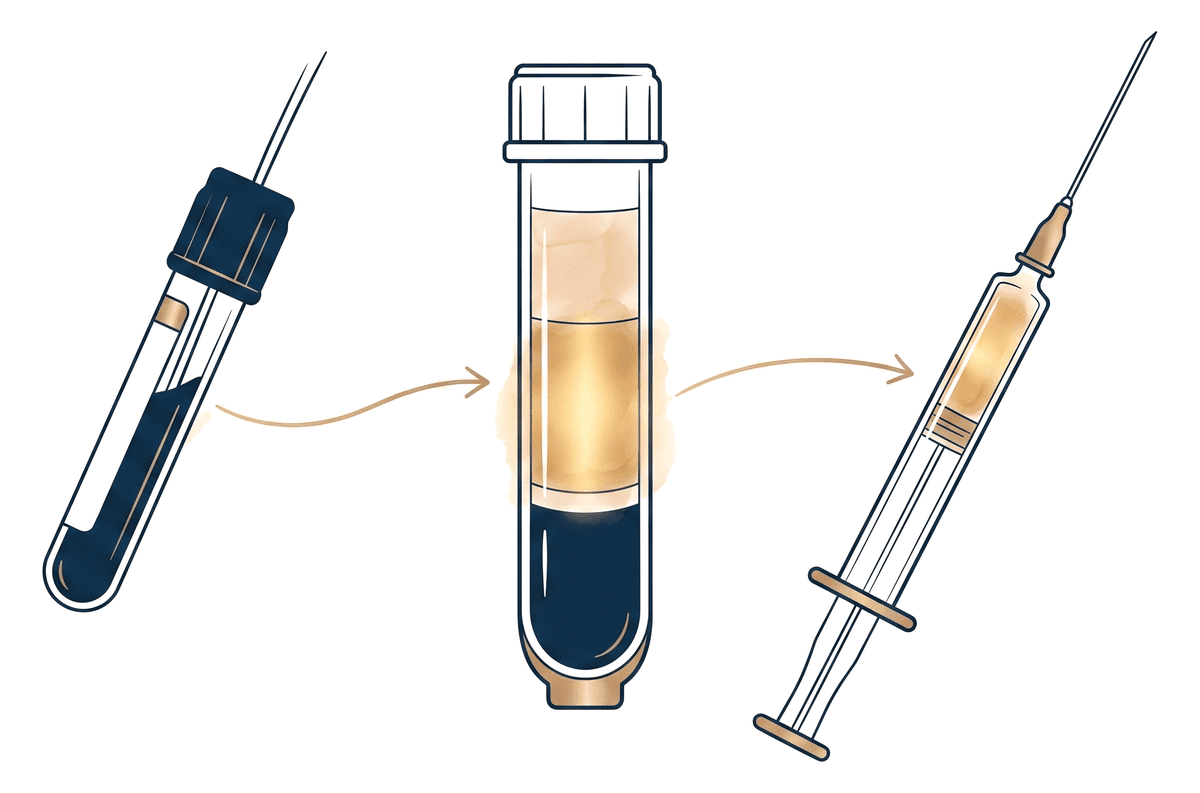
Blood drawn from the arm is separated in a centrifuge; the platelet-rich plasma (the golden middle layer) is separated and concentrated, then applied to the target area with a fine needle.
Tissue renewal with growth factors derived from the patient's own blood. Regenerative support for erectile function and sexual health.
PRP (Platelet-Rich Plasma) is a plasma component prepared from the patient's own blood, with an increased platelet concentration. The drawn blood goes through a special centrifugation process; the platelets and the growth factors they contain are separated and concentrated.
Platelets do more than clot blood; they contain numerous growth factors that initiate tissue repair. These growth factors stimulate new vessel formation, cell renewal and tissue healing. PRP aims to strengthen this natural repair process in the area where it is applied.
Because it is prepared entirely from the patient's own blood, it carries no risk of allergy or rejection. In urology it is considered a regenerative option in areas such as erectile function support and Peyronie's disease.
A note on transparency: PRP is a promising method in regenerative urology; however, the level of scientific evidence is still developing. Expectations should be kept realistic, and treatment should be planned according to the individual's situation.
Blood drawn from the arm is separated in a centrifuge; the platelet-rich plasma (the golden middle layer) is separated and concentrated, then applied to the target area with a fine needle.
PRP is a short procedure completed within the same session. All stages are done under sterile conditions.
A small amount of blood is drawn from the arm — just like a routine blood test.
The blood is centrifuged in special tubes; the platelet-rich plasma layer is separated and concentrated.
The prepared PRP is applied to the target area with a fine needle after a local numbing cream. The process is short.
Tissue renewal develops over weeks. An additional session is applied according to plan if needed.
The main advantages of PRP as a treatment prepared from your own biological source.
Because it is prepared from your own blood, it carries no risk of allergy, rejection or foreign material.
Requires no incision; it is applied only with a fine needle. No recovery period is needed.
Completed in the same session; the patient returns to daily life after the procedure.
Can be planned together with ESWT and medication as a treatment enhancer.
The most common is temporary mild tenderness at the application site. Serious side effects are rare.
Instead of suppressing the symptom, it aims to support the tissue's own repair process.
The most common questions about pain, results and safety.
Because a local numbing cream is used before the application, the procedure is largely painless. Most patients feel only a mild pressure.
Because the effect of PRP is based on tissue renewal, it is not immediate. The benefit usually becomes gradually clearer in the weeks following the procedure.
Both methods are regenerative and often complement each other. Which one, or which combination, is suitable is determined by the cause of the complaint and examination findings.
Usually 1–3 sessions are planned. The exact number is determined by the individual's situation and the response obtained.
It may not be suitable in patients with an active infection, certain blood diseases or a clotting disorder. Therefore, an assessment before the procedure is essential.
Regenerative treatments should be planned individually. Let's assess your complaint and expectations together. Reach out via WhatsApp for a preliminary consultation.