Peyronie's disease shows itself as curvature, pain or a change in shape during an erection, resulting from the formation of a hard plaque (scar) in the tissue inside the penis. It is far more common than thought, but because it is hard to talk about, most men delay getting help. Yet when assessed at the right time, there are effective options.
Why does it happen?
Although the exact cause of Peyronie's is not fully known, it is generally attributed to the formation of abnormal scar tissue during the healing process after small, repeated traumas to the penis. This plaque prevents the tissue from expanding evenly during an erection, leading to curvature. Diabetes and some connective tissue conditions can increase the risk.
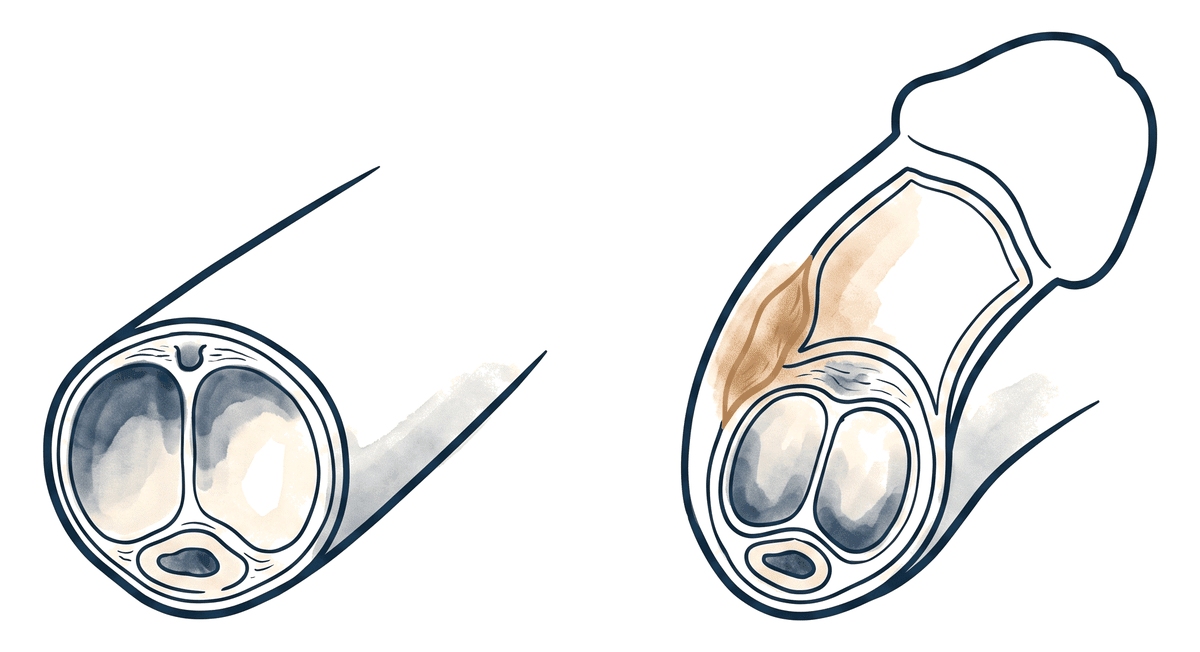
It has two phases
In Peyronie's, the treatment decision depends on which phase the disease is in:
- Active (early) phase: Usually the first 6–18 months. Pain and changing curvature are prominent. In this phase the aim is to slow progression and reduce pain.
- Stable (late) phase: The pain has passed and the curvature has settled. In this phase, surgical options are considered for lasting correction.
Treatment options
In the early phase
- Medication and injection treatments: Aimed at softening the plaque and limiting progression.
- ESWT (shockwave): Can be helpful especially in reducing pain.
- Stretching (traction) applications: In suitable cases, may contribute to limiting the curvature.
In the stable phase
- Surgical correction: Permanent correction of the curvature. The method is chosen according to the degree of curvature and the erectile status.
- Penile prosthesis: If Peyronie's is accompanied by a serious erectile problem, it can be a solution that both corrects the curvature and provides an erection.
In Peyronie's, the most appropriate treatment varies according to the phase of the disease and the person's complaints; not haste, but the right timing matters.
When should you seek help?
If you have newly noticed curvature during an erection, pain, a palpable firmness inside the penis or difficulty with sexual function, assessment is important. Seeking help in the early phase provides an advantage both for managing pain and limiting progression. The assessment is done in confidence.