Unlike most cancers, testicular cancer is most common in young men aged 15–40. Although it may sound frightening, it is one of the cancers where modern medicine is most successful: when caught early, the recovery rate is very high. And the most effective early diagnosis method is not an expensive test but a few minutes a month: the testicular self-examination.
Why self-examination?
The most common first sign of testicular cancer is a painless firmness or swelling felt in the testicle. Because there is usually no pain, the person who notices this change is most often the man himself. The habit of regular examination allows you to catch even the smallest change early.
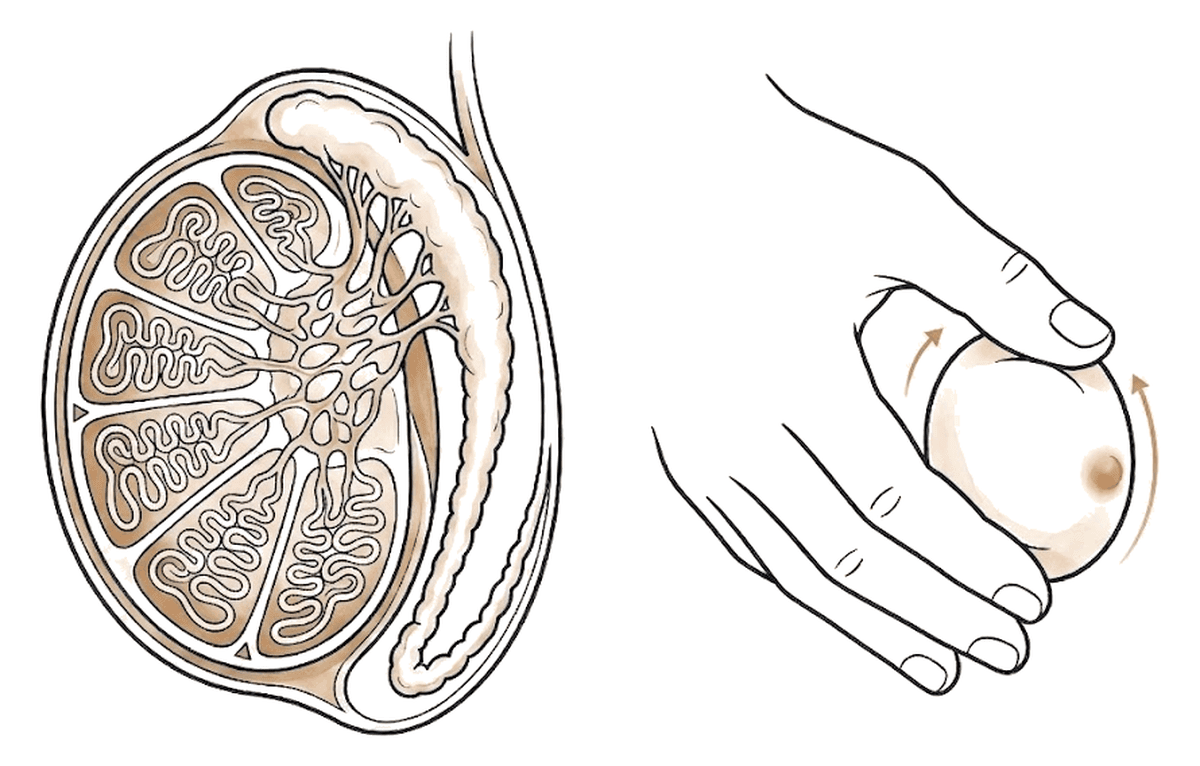
How is a self-examination done?
Just a few minutes once a month is enough:
- Ideal time: After a warm shower, when the scrotum is relaxed.
- How: Gently roll each testicle separately in your hand, with your thumb on top and your other fingers underneath.
- What to look for: A painless firmness, a nodule, or a change in size or consistency. It is normal for the two testicles to be slightly different in size; what matters is a new change.
- Recognize normal structures: There is a soft, coiled structure (the epididymis) at the back-upper part of the testicle; this is normal, not a mass.
The aim is not to diagnose yourself; it is to notice a change early and seek help in time.
What to watch for?
- A painless firmness or nodule in the testicle
- A marked enlargement or change in shape of one testicle
- A feeling of heaviness or fullness in the scrotum
- A dull pulling in the lower abdomen or groin
Most of these symptoms can also be due to benign causes (a cyst, varicocele, inflammation). But only examination and ultrasound can tell the difference — so do not wait when you notice something.
Why is early diagnosis so valuable?
Testicular cancer responds very well to chemotherapy even if it has spread; at an early stage the recovery rate is quite high. Moreover, even if one testicle has to be removed, the other healthy testicle usually continues hormone and sperm production — sexual function and, in most cases, fertility are preserved. If desired, the option of sperm freezing is also discussed before treatment.
Don't be embarrassed, don't postpone
Talking about this topic or seeing a doctor is difficult for many young men. But postponing is the biggest risk. The assessment is fast, confidential and largely painless. Acting early is a sign of strength.