In the treatment of prostate enlargement (BPH) there is no longer a single "best method"; the right method changes according to the right patient. HoLEP and Rezum are the two most current options in this area. In this article, by placing them side by side, we explain in plain language which one may suit whom.
In brief: what are the two methods?
HoLEP (Holmium Laser Enucleation) is an operation in which the enlarged prostate tissue is removed as a whole from its capsule with the holmium laser. It has efficacy equivalent to open surgery, but is applied with an endoscopic — that is, minimally invasive — method. It is considered the gold standard in prostates of any size, especially large ones.
Rezum (Water Vapor Therapy) is based on gradually shrinking the enlarged tissue with 103°C water vapor delivered into the prostate tissue. It is a minimally invasive method that can be applied on an outpatient basis, under local anesthesia, and largely preserves sexual function.
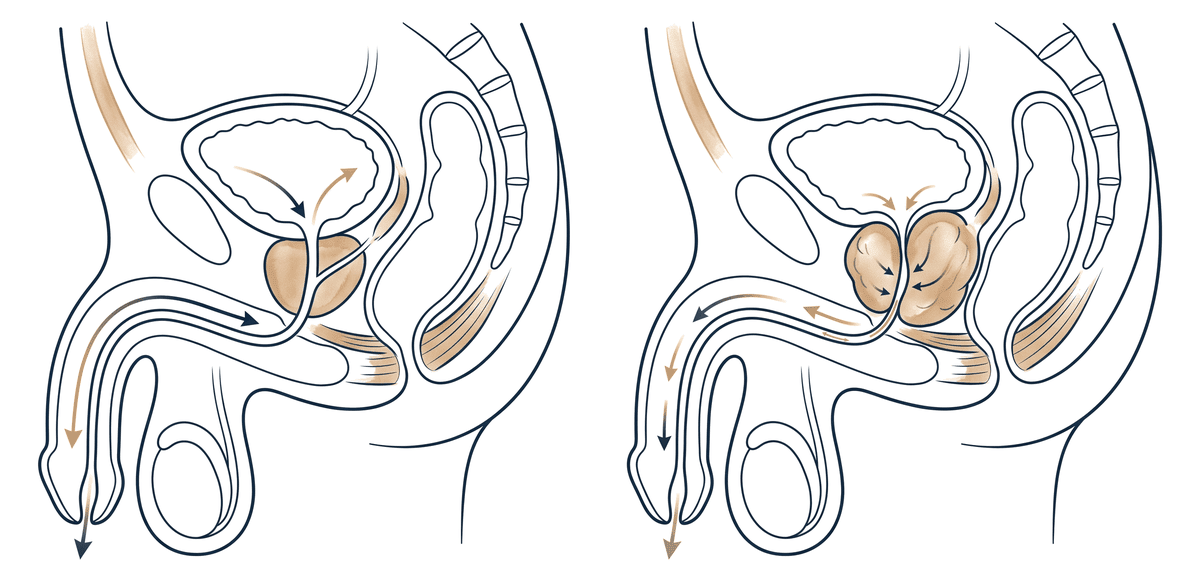
Key differences
Prostate size
Rezum is ideal in small and medium prostates (roughly 30–80 ml). HoLEP, on the other hand, knows no size limit; it is effective even in large, or very large, prostates over 80 ml. If your prostate is large, the choice often leans toward HoLEP.
Anesthesia and procedure
Rezum can be applied on an outpatient basis with local anesthesia; the procedure is short. HoLEP requires general or spinal anesthesia and usually involves a one-night hospital stay.
Sexual function
This is a critical issue for many patients. Rezum has the advantage of largely preserving sexual function and ejaculation. HoLEP does not affect erections; however, in a significant proportion of patients "retrograde ejaculation" develops — semen flows back into the bladder instead of out. This does not reduce sexual pleasure, but for those who wish to have children it should be discussed in advance.
Durability
Because HoLEP removes the tissue as a whole, its durability is very high; the need for repeat treatment is below 1%. Rezum's effect is also lasting, but over time a small proportion of patients may need additional treatment.
Recovery
After Rezum the patient usually returns home the same day; the full effect settles in within a few weeks. In HoLEP the catheter is removed within 24–48 hours, and return to work is about one week.
In short: Rezum is a "preserve and shrink" approach, HoLEP a "remove entirely" approach. Both are proven, safe methods.
Who is more suited to which?
Rezum stands out in these situations:
- Those with a small-to-medium prostate
- Those who want to preserve sexual function and ejaculation
- Those who prefer an outpatient, gentle procedure
- Patients who want to avoid, or cannot have, general anesthesia
HoLEP stands out in these situations:
- Those with a large prostate (80 ml and above)
- Those who want a lasting, one-time definitive solution
- Those on blood thinners (HoLEP is advantageous here)
- Those with additional problems such as bladder stones
How is the decision made?
The right choice is made by assessing together the size of your prostate, the severity of your complaints, your sexual function expectations, your general health and your personal preferences. Uroflowmetry, PSA, ultrasound and examination findings clarify this decision. What matters is that the options are explained to you clearly and the decision is made together.