In kidney stone treatment there is no single method; the right method is chosen according to the size, location and hardness of the stone and the patient's situation. The good news: with advances in technology, open surgery has almost become history. Today, most stones can be treated incision-free or with a very small intervention.
First: does every stone require treatment?
No. Most small stones (usually under 5 mm) can pass on their own with plenty of fluids and, when needed, stone-passing medication support. Treatment comes into play if the stone is large, causes obstruction, does not pass, or leads to severe pain or infection.
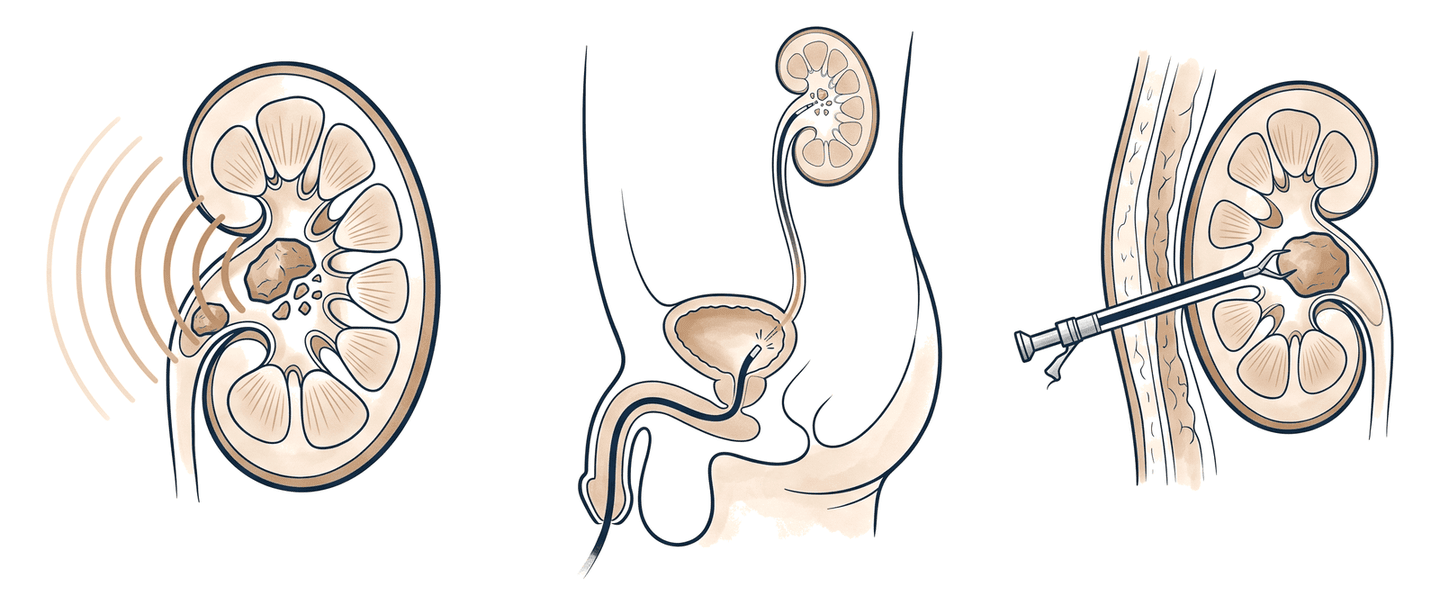
Modern treatment methods
ESWL — Breaking stones with sound waves
It is based on breaking the stone with shockwaves sent from outside the body. It is completely incision-free and is usually applied under sedation. It is effective in stones of a suitable size and location; however, not every stone is suitable for ESWL — the hardness and location of the stone matter.
RIRS / URS — Minimally invasive laser method
Entering through the urinary tract, the stone is broken up and cleared with the help of a flexible or rigid endoscope and a laser. There is no skin incision. It is preferred especially in medium-sized stones and in situations where ESWL is not suitable. The stone is turned to dust with the laser; recovery is usually fast.
PCNL — Percutaneous kidney surgery
In large stones (usually over 2 cm) or staghorn stones, the stone is cleared by entering through a very small opening made from the skin to the kidney. It is the most effective method for resolving a large stone burden in a single session.
The aim is not only to clear the stone; it is to achieve the highest stone-free rate with the least intervention.
Which method for which stone?
A general framework is as follows (the exact decision is individual):
- Small stones: Spontaneous passage with follow-up and medical treatment.
- Small-to-medium stones: ESWL or RIRS/URS.
- Medium-to-large and hard stones: RIRS/URS.
- Large stones: PCNL.
The right method is determined by assessing the tomography findings, the hardness of the stone and its location together.
After treatment: preventing recurrence
The job is not done once the stone is cleared. People who have passed a stone once are at high risk of recurrence; that is why plenty of fluid intake, dietary adjustments and, when needed, measures based on stone content analysis are important.